Address
Handunugoda Tea Factory
Tittagalla, Ahangama,
Sri Lanka.
Open Hours
Open Daily 8:00 AM – 4:30 PM
Phone Numbers
(+94) 77 206 5555
(+94) 77 972 0095
(+94) 91 228 6364

Address
Handunugoda Tea Factory
Tittagalla, Ahangama,
Sri Lanka.
Open Hours
Open Daily 8:00 AM – 4:30 PM
Phone Numbers
(+94) 77 206 5555
(+94) 77 972 0095
(+94) 91 228 6364
It rolled in low over the central highlands, soft as breath, clinging to the green slopes where tea bushes rose in careful rows. Dawn light slipped in behind it, painting the hills with faint gold. From the workers’ line of houses came the sounds that meant another day on the estate had begun: kettles whistling, doors creaking, the murmur of voices and the clink of tin mugs.
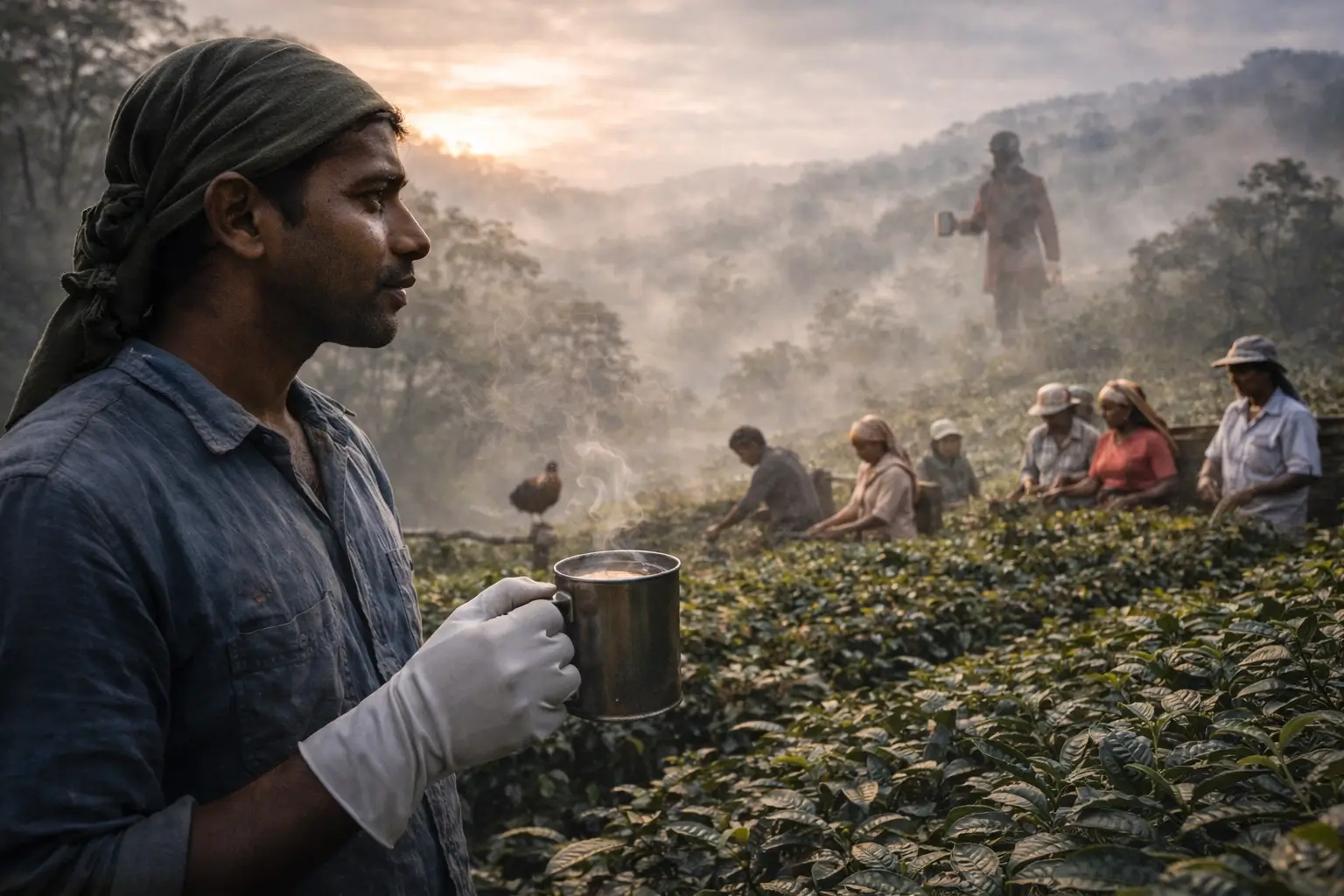
It rolled in low over the central highlands, soft as breath, clinging to the green slopes where tea bushes rose in careful rows. Dawn light slipped in behind it, painting the hills with faint gold. From the workers’ line of houses came the sounds that meant another day on the estate had begun: kettles whistling, doors creaking, the murmur of voices and the clink of tin mugs.
Ravi sat on the step of his small house, hands wrapped around a steaming cup of tea. The dark liquid swirled thick and strong, streaked lighter by the milk his mother had poured. When he lifted it to his lips, he caught the familiar notes: malty and deep, with a hint of spice and something bright at the edges, almost like bergamot.
Flowery Small Leaf—the estate’s English Breakfast alternative. The workers’ tea. His tea. “Drink, putha,” his grandmother called from inside. “The leaves are waiting.”
He finished in three steady gulps, warmth spreading through his chest, and grabbed his shears.
Up on the hill, the tea bushes were beaded with dew. Women and men in faded shirts and wide-brimmed hats moved along the rows, their hands and shears working in practiced rhythm. Snip. Drop. Snip. Drop. The air was sharp with the green scent of fresh leaf, undercut by the smoke from morning fires drifting up from the village.
“Ah, our soldier is here,” called Nadeesha, a friend from childhood, as Ravi joined her row. “Ready to fight the bushes again?”
“Every day,” he said. “The enemy never learns.”
A mynah bird on a nearby post squawked, “Snip-snip! Hurry-hurry!” then laughed at its own joke. Ravi smiled, but the weight behind his ribs didn’t lift.
This season, the news had not been kind. Global prices were low. The estate manager had gathered them under the shade of the big mango tree and talked of “fluctuations” and “temporary adjustments.” Wages threatened to slip. The small school down in the village—the one with the cracked blackboard and the bright-faced teacher—might lose its funding. The community fund that helped families through the monsoon months was running dry.
Whispers traveled faster than the mist.
“They’ll sell the estate,” someone said.
“A big company will buy it,” another added. “Bring machines. No need for our hands.”
Ravi listened and kept working, fingers steady, but anxiety pulled at him like a leech. He was twenty-six, son of pluckers and grandson of pluckers. He could read a little, add numbers, fix a broken thatch roof—but he did not want to leave these hills for a city job in a garment factory or a hotel where his name would be forgotten.
He liked the feel of the leaves between his fingers. The way the land answered when you treated it well. He liked waking to the same view his ancestors had known.
But what if the hills no longer needed him?
That evening, after the sun slid down and the last baskets had been weighed, Ravi sat with his grandmother on their verandah. The sky was the color of cooled tea; the air vibrated with crickets and the occasional burst of laughter from neighboring houses.
His grandmother, Saraswathi Amma, wrapped her shawl tighter around her shoulders. Her hands, knotted and strong, rested on her knees.
“You’re frowning so hard, I could hang my wet clothes on your eyebrows,” she said. Ravi snorted. “The estate might be sold. They say machines can do our work cheaper.” “Machines don’t drink tea,” she replied. “Not yet, anyway.”
He almost laughed, but it caught.
“What if they’re right, Achchi?” he asked. “What if we are just… extra?”
She turned her head slowly, eyes reflecting the last of the light.
“Do you remember the Soldier of the Leaves?” she asked.
“That story is for children,” he said, though he knew every line of it.
“Then good,” she said. “It will be easy to understand.”
She told it again, her voice slipping into the cadence of the old days.
Long ago, when British overseers still rode horses along these slopes, a soldier had come to the estate. He wore a red coat faded to earth tones, boots dusty, hat in his hand. He watched the workers pluck through rain and heat, watched them share their meager food, watched them carry each other’s loads when one was tired.
One evening, as a storm broke over the hills, the soldier appeared at the line rooms, carrying a tin mug. “I was told strength comes from orders,” he said, “but I see now it comes from this.”
He poured tea from a battered kettle—strong, black, no sugar. “True strength is not in conquering land,” he said, “but in the way you show up for each other every day.”
He promised that as long as the workers stayed loyal to one another—as long as they shared their burdens and gains—the land would answer with enough. The tea would stay strong. And sometimes, when fog hugged the ground, they said you could still see him: a faint figure in a red coat, tin mug raised, watching over the fields.
“Stories don’t keep wages up,” Ravi muttered, though more softly now.
“No,” his grandmother said. “We do.”
She reached over, squeezed his arm. “The Soldier of the Leaves was never about some ghost. It was about us. About choosing to stand together.”
The next days, a restlessness settled into Ravi’s bones.
He plucked by day and thought by night. He watched how the younger workers dreamed of Colombo, of Dubai, of anywhere but here. He remembered how, when he was a boy, the estate had operated as a kind of cooperative: shared harvest festivals, bonuses divided fairly, families helping those whose crops had failed.
Somehow, under pressure, that had frayed. People kept more to themselves. Suspicion replaced generosity in little ways.
One evening, Ravi walked the paths between the houses, stopping here and there. “Come to the community hall tomorrow after work,” he told them. “Just to talk. To drink tea.” “A meeting?” Nadeesha asked skeptically. “You’re not the manager.”
“No,” he said. “I’m just someone who drinks a lot of Strong Tea and is tired of worrying alone.” The mynah bird overhead called, “Talk-talk! Late-late!” and everyone laughed. Laughter was a good sign.
At the hall, with its peeling paint and dusty windows, they gathered in twos and threes. Ravi’s grandmother made a huge pot of Flowery Small Leaf—brewed thick, with milk and a touch of sugar. Tin mugs were passed around.
“Machines may come,” Ravi began, voice low but steady. “Prices may drop. But we are still here now. We can still decide how we stand together.”
He spoke of reviving the cooperative fund properly—each worker setting aside a small portion, matched by the estate if they could negotiate it. Of taking turns helping repair each other’s houses. Of organizing to ask the manager for transparency about prices. Of trying small changes in the fields—planting shade trees where the sun burned hottest, using natural pest plants instead of chemicals when possible to improve leaf quality.
“This tea,” he said, lifting his mug, “is strong because many hands brought it here. If we hold together, we give it a story no machine can crush.”
Some were doubtful.
“Will it change the market?” one man asked.
“Maybe not,” Ravi said. “But it will change us. And if we improve the leaf, if we show we are worth more than they pay—we’ll be ready when a better chance comes.”
“And if it never comes?” Nadeesha asked.
“Then at least we were honest with each other,” he answered.
It was not a grand speech, but it was sincere. People nodded. They drank. They signed their names or marks on a new cooperative ledger his grandmother had kept hidden since her youth.
That night, Ravi dreamed of the Soldier of the Leaves.
In the dream, the spirit sat on a rock at the edge of the plantation, coat turned brown with age, tin mug in hand. He poured tea for a line of workers—past and present, faces Ravi recognized and some he did not.
“Strong enough?” the Soldier asked.
Ravi tasted. The tea was robust, with that lifting edge of something bright. It tasted like effort. Like shared shoulders.
“It will do,” the Soldier said, and his eyes held a quiet pride.
Weeks passed.
The community fund slowly refilled. Experiments in the fields paid off: the shade trees softened the harshest sun, and natural pest control reduced damage. The Flowery Small Leaf from their side of the estate was tastier than ever—full-bodied, aromatic, with that subtle bergamot lift that made it stand out even with milk added.
Still, prices remained low. The estate manager wore deeper grooves between his brows. One afternoon, he called them together beneath the mango tree.
“We have received an offer,” he said heavily. “A company from abroad. They will buy the estate. Mechanize most of the plucking. Some of you will keep jobs. Many will not.” His voice broke slightly. “It may be the only way to keep anything open.”
Murmurs turned to arguments. Some were ready to accept. They were tired. They had children to feed. Hope can only stretch so far.
Ravi felt the air tighten like a too-full basket. The future seemed to narrow into a thin, hard line. “Wait,” he said. “At least… drink tea together first.”
He went to the cooperative’s small storeroom and brought out a carefully guarded tin: the last batch of their very best Flowery Small Leaf—hand-picked from the highest bushes, processed with extra care, saved “for a special time,” his grandmother had said.
“If this isn’t special, I don’t know what is,” he muttered.
They brewed it in a large battered teapot, poured it into mugs, clay cups, anything that would hold liquid. The aroma rose rich and comforting, heavy with malt and warm spice, the bright top note cutting through like a kind word in a hard day.
As they drank, something shifted.
People fell quiet. Shoulders dropped. Eyes softened. The taste was familiar, but somehow more intense—years of early mornings and tired laughter condensed into one strong, steady sip.
“It tastes like the old days,” an elder said. “When we believed in ourselves.”
“It tastes like us,” Nadeesha whispered.
At the edge of the crowd, an older worker, Bandara, cleared his throat.
“There is something I must tell you,” he said. “Some will call me mad. That’s alright; you already do.” Weak laughter rippled. Bandara had always been a bit odd—quiet, watching the hills more than people.
“Years ago,” he continued, “when we first spoke of cooperatives and fairer pay, I took a small parcel of our best Flowery Small Leaf and sent it abroad. To a fair-trade buyer I heard about on the radio. I wrote a letter about us. About this estate. About how we want to stand together.”
He held up his hands. “I did not tell you because I did not want to raise hope. I never heard back… until last week.”
As if on cue, a jeep rumbled up the dirt road, stopping near the tree.
A woman stepped out, light-skinned, with wind-tangled hair and dust on her shoes. She carried a small leather notebook and a worn backpack. Her Sinhalese was accented but careful.
“My name is Emily Hart,” she said. “My company sources fair-trade teas. I received a letter some time ago, with samples of a very strong, very honest tea. I’ve been searching for this place ever since our buyer nearly cried over his morning cup.”
She smiled, a little shy. “He said, ‘This tastes like people who don’t give up.’”
The manager blinked. “You… want to buy our tea?”
“Yes,” she said. “If you are willing, we want a long-term partnership. Fair prices above market. A fund for your school and clinic. Your stories and faces on the boxes. We’d like to call it **‘Workers’ Breakfast – Flowery Small Leaf from the Highlands’. The kind of tea you drink when the day is hard, but you’re not alone.’”
Bandara let out a breath he’d been holding for years. Ravi felt his chest warm in a way that had nothing to do with tea.
The offer from the mechanized buyer, which had felt like a lifeline, now looked like a leash.
They did not vote quickly. They asked questions. They argued. They checked Emily’s papers and looked into her eyes. But in the end, when the choice came, their hands went up—not for the quick sale, but for the harder road of staying together.
The estate chose community.
Months later, dawn in the highlands looked much the same: mist, hills, line of workers. But the line of houses had new roofs. The school had fresh paint, and children’s laughter spilled from its doors. A small clinic opened twice a week. The cooperative fund was strong enough that no family went hungry during the last monsoon.
The new partnership meant more work in some ways—visitors to host, standards to maintain—but it also meant pride. On the boxes shipped overseas, next to the picture of a faded red soldier standing guard over rows of tea, were small portraits of the pluckers themselves, names printed clearly.
Flowery Small Leaf – Workers’ Breakfast became a quiet success in distant supermarkets and specialty shops. People wrote back, sending letters and photos: a nurse in London holding up a mug before a night shift; a bus driver in Berlin; a teacher in Melbourne. They thanked the estate for “strong mornings.”
Ravi found himself called “aiya” a little more often by younger workers seeking advice. He did not feel like a leader, only like someone who kept showing up. But perhaps that was enough.
One morning, he stood with his grandmother at the top of the hill, tin mugs in hand. The tea inside was dark and fragrant, swirled with milk.
“You see, putha?” she said, sipping. “The Soldier of the Leaves was never a story about empire. It was always about us. About how we hold each other up.”
As the mist thinned, Ravi thought he saw, just for a moment, a figure standing at the far end of the rows—a silhouette in a faded red coat, tin mug raised in silent toast, then gone.
He smiled and lifted his own mug toward the empty air.
Far away, somewhere under a different sky, someone else lifted a strong, steaming cup to their lips—perhaps not knowing Ravi’s name, or the exact shape of the hills he walked each day, but tasting his world all the same.
And with every deep, steady sip of their morning tea,
they made, without words, the same quiet choice he had—
to value the hands that keep the world turning,
one small, flowery leaf at a time.